Wave Field Synthesis (WFS) is a computationally expensive but very powerful and advanced way of creating highly immersive audio environments. The basic theory behind it is not very complex, but the technological effort is immense: A huge array of independently controlled speakers is used to create the same pressure wave as a virtual source located somewhere behind that array of speakers - or, even more impressive, in between those speakers and the listener. By doing so, WFS allows to create sound sources literally anywhere in that space.
The total costs of such a system with its hundreds of speakers, amplifiers, multichannel audio interfaces and rendering computers is very high. Therefore WFS systems currently can only be found in a few selected locations, and rarely in commercial setups. German company IOSONO is one of the pioneers of commercial WFS systems.
One of their systems was installed in 2009 for several months at Berlin's legendary techno club Tresor. Robert Henke has been invited to prepare a special Monolake performance using and exploring that system. The following text describes some of the ideas behind this special concert:
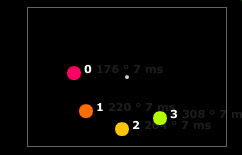
The November 2009 Monolake Live set is a four channel surround set. All direct sources (synthesized percussions, basslines and other sounds) and the various audio effects are mixed together into a quadrophonic sound stream. That sound stream is then modified by optional additional processing in order to achieve subtile or dramatic changes in the spatial perception of the sounds.
For the WFS set we chose a different approach: Since we can operate with much more input channels and place each input dynamically in the listening space, we will split the signals into multiple groups of sounds, which can be processed individually and sent to the WFS system. This approach will allow to place different aspects of the music in constantly moving spatial locations, and by doing so achieving a much higher level of immersion for the listener.
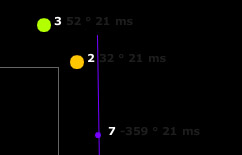
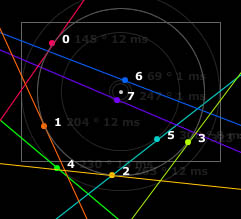
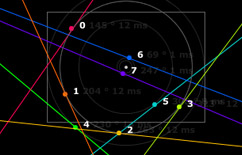
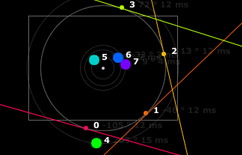
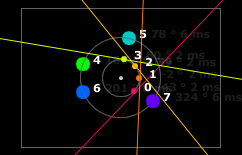
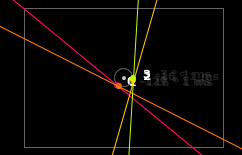
The modification of the current four channel Monolake Live Surround set includes two parts: The splitting of the output signals into the submix streams. And the spatial control of that streams. The later is been done by a specially developed MAX patch, named 'Monoloke-WFS-Control' . It talks to the WFS system via OSC and allows to manipulate the position of the virtual sources in realtime during the performance. This manipulation includes dynamic changes such as moving or rotating sources. The patch itself consists of three elements: A graphical user interface that allows to observe the position and the state of each virtual source (e.g. point source or plane wave), the driver that communicates with the WFS rendering computers, and the gestural control modules. These modules define movements and 'scenes' of positions that can be recalled and modified during the performance.
Whilst the technological side of is straight forward, the practical and artistic implications are not. Partly because a club is not an ideal setting for a WFS system anyway; the theory is supposed to work in a room with no signals bouncing off the walls. A normal club is very much a mirror in this regard. This will introduce ambiguities in the perception; a source that is meant to be in front of a listener might show up behind or next to him/her due to reflections. The second problem already affects the current Monolake Live Surround performances: The localization of sound is mostly done by the human brain via phase- and volume-differences of mid range signals. Wearing earplugs massively compromises that localization. Brutal loudness and precise sound exclude each other very much.
The concert happened on December 10 2009 in Berlin at Club Tresor. It turned out that the audience liked most the effects of sound suddenly appearing right inside their heads, when they were 'hit' by a moving source. Whilst I find it questionable to have such a system as enhancement for a normal DJ set, it was a lot of fun and quite inspirational to use it in a concert situation with multiple independent sound sources. There is a lot to discover here...
Screenshots on this page are from the first interface drafts of the 'Monolake WFS Control' software.